— Atlantic Canadian Ports to Welcome 950,000 Cruise Guests Aboard Over 600 Ships in 2023 Season —
For Immediate Release
April 20, 2023
Halifax, Nova Scotia – Atlantic Canada’s cruise industry is preparing for a banner year in 2023 with the region expected to welcome nearly 1-million cruise guest visits aboard over 600 vessel calls across the region. From late April until early November, ports across the region will be bustling with travelers from around the world. This news is a welcome relief for tourism operators, local businesses, and job growth, all of which benefit from the increased economic activity generated by the cruise industry.
“We’re thrilled to have such a promising cruise season ahead of us,” says Sarah Rumley, Executive Director of the Atlantic Canada Cruise Association (ACCA). “The number of ships and passengers expected this year is unprecedented, and it demonstrates the strength and resilience of the cruise industry in Atlantic Canada.”
The 2023 cruise season will begin on April 21, with the niche port of Lunenburg, Nova Scotia, welcoming Viking Cruises’ Viking Octantis.
Several cruise ships will be making their debut in the region this season, including Explora Journeys, Explora 1, a new privately owned luxury lifestyle brand of the MSC Group, headquartered in Geneva, Switzerland. Another ten ships are expected to call Atlantic Canada for the first time, highlighting the increasing popularity of the region as a cruise destination.
Before the pandemic, cruise ships contributed $347 million to Atlantic Canada’s economy and were responsible for over 2,000 jobs. When cruise operations resumed last year after a two-year hiatus, ports welcomed 474 ships and 622,811 passengers. With even more promising projections for 2023, a banner year is proof positive that post-pandemic recovery in the sector is well underway.
“ACOA is pleased to support the cruise industry as it showcases Atlantic Canada to the world during this anticipated record-breaking year,” says the Honourable Ginette Petitpas Taylor, Minister of Official Languages and Minister responsible for the Atlantic Canada Opportunities Agency (ACOA). “The cruise industry plays a key role in tourism, drawing people to these special places, creating jobs and growing the economy for years ahead.”
With its stunning coastline, picturesque towns, and friendly locals, Atlantic Canada offers unique and memorable experiences for visitors, each port has something special to offer, from New Brunswick’s magnificent Bay of Fundy, Newfoundland and Labrador’s breathtaking scenery, Prince Edward Island’s vibrant culinary scene or Nova Scotia’s rich culture and historic sites. The cruise industry’s continued growth in the region provides local businesses with ample opportunities to grow and thrive, making 2023 an exciting year for the entire Atlantic Canada community.
– 30 –
For more information:
Sarah Rumley
Executive Director, Atlantic Canada Cruise Association
director@cruiseatlanticcanada.com (902) 229-4304
About Atlantic Canada Cruise Association (ACCA)
Operating as Cruise Atlantic Canada, ACCA is a regional partnership between ports, tourism, and cruise ship interests as well as the four provincial governments and the Atlantic Canada Opportunities Agency. We work to promote the sustainable growth of Atlantic Canada as a cruise destination through strategic leadership, collaboration, partnerships, and innovative marketing. Find out more at https://www.cruiseatlanticcanada.com/.
The routing decisions of airlines have a direct impact on visitation and the announcement today by the Province, will enable Nova Scotia airports to compete with destinations around the world vying to increase access.
As we begin the rebuild for both tourism and trade, the role of HIAA will be key in our success. Their ability to attract direct flights linking Nova Scotia to larger urban centers in North America Europe and beyond is crucial as we compete with global destinations vying for the same customer.
“HIAA boasts a world class International Airport that serves as a hub for Atlantic Canada. This is a strategic investment and we applaud Premier Houston for listening to the Nova Scotia tourism industry,” says Wes Surrett, TIANS Chair. “TIANS has been advocating for increased support and flexibility for air access. This will have positive economic returns for the sector and the government with increase tax revenue through growth.”
“The Nova Scotia tourism industry lost over $3 Billion in revenue in 2020 and 2021,” says Darlene Grant Fiander, TIANS President. “The announcement today will go a long way to helping us get back to pre-pandemic levels of annual revenue of $2.6 Billion plus potential for significant growth in the coming years.”
Working with partner associations and stakeholders, TIANS is committed to representing the best interests of the Industry; enhancing and supporting the development of a competitive business environment; advocating on issues critical to the Industry’s success; and most importantly, leading Nova Scotia’s most promising economic sector.
-30-
For more information, please contact:
Lisa Dahr
Director, Industry Relations and Professional Development
Tourism Industry Association of Nova Scotia
lisa@tourism.ca 902.423.4480 www.tians.org
Download PDF Version Here
Air Announcement Release May 6, 2022
Canadian tourism businesses can now apply for support in the NEW Tourism Relief Fund
July 12, 2021 (OTTAWA, ON) – The Tourism Industry Association of Canada (TIAC) is heartened by the new Tourism Relief Fund outlined in the July 12, 2021 announcement by the Honourable Mélanie Joly, Minister of Economic Development and Official Languages.
TIAC has been working tirelessly with industry partners requesting targeted support for the tourism industry. As part of the Coalition of Hardest Hit Businesses, TIAC and its colleagues are encouraged to see the creation of the Tourism Relief Fund (TRF).
“The tourism industry continues to face significant hardship due to the onset of the Covid-19 pandemic. During today’s press conference, Minister Joly acknowledged the unique set of factors our suite of sectors has endured, and repeatedly highlighted the fact that the tourism industry was first and hardest hit,” said Beth Potter, President & CEO of TIAC.
“We appreciate the announcement of additional funds to the industry through the Tourism Relief Fund, with a focused lens to ensure support to Indigenous operators. While it is not going to solve all problems, this funding could make the difference between a business being able to stay in operation and employ staff throughout the long road to recovery. We encourage all tourism businesses and organizations to check with their Regional Development Agency to find out how they can take advantage of this funding.”
The TRF will provide $500 Million in support for the tourism sector over a two-year period. The majority of the funding, $485 million, will be delivered by Regional Development Agencies (RDAs) directly to tourism businesses and organizations to help aide in the creation of new tourism experiences, or enhance existing ones. Of this $485 million, a minimum of 10% will be invested in Indigenous tourism projects.
Additionally, $15 million will be delivered by Innovation, Science and Economic Development Canada (ISED) to support destination development, seasonal and local attractions, human resources and skills development.
Funds delivered to businesses will be either non-repayable (contributions up to $100,000) or repayable (contributions up to $500,000). Not-for-profit organizations and Indigenous organizations (not generating profits) will be eligible for non-repayable contributions.
To find out if your organization qualifies for TRF funding and to apply, visit your regional development agency‘s web page:
➜ Atlantic Canada Opportunities Agency (ACOA)
For communities in Atlantic Canada
➜ Canada Economic Development for Quebec Regions (CED)
For communities in Quebec
➜ Canadian Northern Economic Development Agency (CanNor)
For communities in Canada’s three territories
➜ Federal Economic Development Agency for Southern Ontario (FedDev Ontario)
For communities in southern Ontario
For communities in northern Ontario
➜Western Economic Diversification Canada (WD)
For communities in Western Canada

]]>
VIEW OPEN LETTER TO MINISTER FREELAND
Since the beginning of the COVID-19 pandemic, businesses in the travel and tourism sector have been devastated by necessary public health restrictions, border closures, travel bans, and the loss of international and domestic travellers. The CEWS and CERS programs have been lifelines for these businesses that would otherwise have been forced to close. With these two key financial relief measures winding down as of July 4th, many CHHB members are facing a near-certain financial crisis that will hit especially hard in the fall and winter of this year.
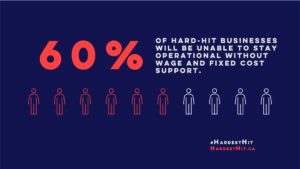
“Our members need these programs to survive,” said Beth Potter, President and CEO of the Tourism Industry Association of Canada. “Our most recent survey from June shows that nearly 60% of Canada’s hardest hit businesses will not survive if CEWS and CERS are not extended. This, together with the increased uncertainty around the reopening of our international borders, the absence of major tourism events and conventions, and the slow return of business travel means we could see a potential collapse of our industry.”
“Our industry was the first hit, the hardest hit, and will be the last to recover,” said Susie Grynol,
President and CEO of the Hotel Association of Canada. “We know that recovery for our businesses will be slower than other sectors; it will not happen with the flick of a switch. For our members who are directly tied to international and business travel, and major events and festivals that need much more lead time to plan, continued and tailored wage and fixed cost support will be needed for those that need it most to ensure we can get to the other side.”
“The tourism industry employs thousands of Canadians,” said Philip Mondor, President, Tourism HR Canada. “The wind down of these programs will mean many businesses will have to let staff go and millions of Canadians will be out of work.”
If businesses in the hardest-hit sectors are allowed to fall victim to the unfortunate timing of CEWS and CERS withdrawal, staggered travel and tourism reopening, and Canadians’ unavoidable urge to exit the country in cold months, we will see the loss of our vibrant tourism and travel industry, that was previously Canada’s 5th largest sector in GDP contribution. This means that small communities will no longer be able to support tourism, major cities will no longer be able to compete for major meetings and conventions, festivals and cultural events, remote communities will be lacking in critical infrastructure for emergency services, and the livelihoods of more than two million people – mostly women, youth and immigrants – will be at risk. A few months of financial support will avoid years of economic and social disruption.
The Coalition underlined that Finance Canada has justified winding down the subsidies because they potentially provide a disincentive for businesses to reopen and rehire employees. While this could be true for businesses dependent on a domestic customer base, it is not true for businesses in the tourism, travel and accommodation sectors that are still under heavy restrictions and international visitors are prohibited from coming to Canada.
Lastly, the Canada Recovery Hiring Program (CRHP) is being boasted by the government as the program to replace the CEWS. However, it is inadequate for businesses that are not recovering. CRHP only provides funding to businesses to hire or rehire staff as business activity recovers. “Without continued tailored support for businesses that have been hardest hit, many tourism businesses across Canada will face difficult decisions on reopening, and won’t be able to pay their bills to be around in 2022 ,” said Potter.
-30-
Established in September 2020, the Coalition of the Hardest Hit Businesses is an industry-driven
coalition that represents the hundreds of businesses in tourism, travel, arts and culture, events and
festivals, motor coach, accommodations and hospitality, and Indigenous tourism experiences.
Despite ongoing restrictions, tourism gained employment in May, adding 45,800 workers. There were gains in full-time employment offset to a degree by declines in part-time employment. Tourism employment increased in all provinces except for Nova Scotia, where employment fell by 2,200 jobs.
Seasonally unadjusted employment across all industries increased by 288,700. Once again there is a large discrepancy between the unadjusted and adjusted data. Despite these gains, the seasonally adjusted data shows an employment loss of 68,000. Essentially, because the economy did not add as many jobs as it usually does in May. Applying seasonal adjustments results in a decrease. The data collected was for the week of May 9th to 15th.
The seasonally unadjusted tourism unemployment rate decreased from 11.3% to 9.8%. In April the unemployment rate had dropped from 13.0% to 11.3%.
This will partially be due to the increase in employment. But our stakeholders should also be aware that Statistics Canada only links unemployed workers to their former industry for one calendar year. After that, they are counted as unclassified. Due to this the tourism unemployment rate—and by extension the unemployment rate for any industry—should be used with caution. The decreasing unemployment rate does not necessarily mean that tourism workers who have been unemployed for over a year have found a new job, or dropped out of the labour force.
There were a mix of employment gains and losses by industry this month.
| Industry Group | Employment Change | Full-time Employment | Part-time Employment |
| Accommodations | 900 | 700 | 200 |
| Food and Beverage Services | 24,600 | 34,300 | -9,600 |
| Recreation and Entertainment | 27,200 | 24,400 | 2,800 |
| Transportation | -6,300 | 3,300 | -9,600 |
| Travel Services | -600 | -1,400 | 800 |
Compared to last year there have been significant employment gains. Last May a few businesses that could were starting to reopen, but for the most part the economy was still shutdown. It will only be in June, and more so in July when comparing monthly data for 2020 and 2021 becomes useful.
Compared to May 2019, employment in all industry groups remains well below what it should be.
| Industry Group | Employment Change – May 2020 to 2021 | Percent Change May (2020 to 2021) | Employment Change – May 2019 to 2021 | Percent Change May (2019 to 2021) |
| Accommodations | 10,900 | 10.6% | -66,200 | -36.7% |
| Food and Beverage Services | 185,100 | 34.6% | -253,100 | -26.0% |
| Recreation and Entertainment | 60,600 | 18.6% | -120,300 | -23.7% |
| Transportation | 36,200 | 14.4% | -88,700 | -23.6% |
| Travel Services | 13,200 | 43.6% | -10,200 | -19.0% |
Bonus Data – Strong Indications of Labour Shortages this Summer
Our new data supports the argument that rural tourism businesses—especially those close to urban areas—will face labour shortages this summer (based on looking at employment levels for 2020 and 2021 and compared them to the same month in 2019).
Tourism employment is down in all regions. But some regions have recovered more than others. The rural areas connected to cities (CMAs) and larger towns (CAs) have done the best, followed by the fringe areas of CMAs/CAs. Fringe areas are the smaller towns/villages that are not directly attached to larger centres but are considered part of the census metropolitan area/census agglomeration. Greely would be an example. It is part of the Ottawa CMA but not directly attached to the main urban area.
One reason the rural areas attached to urban centres might see labour shortages this summer is because overall employment in those areas has fully recovered and exceeded employment levels in 2019. Core regions still have less employment than in 2019. Part of this may be because of people moving from urban cores to exurban areas. (Although we don’t have hard evidence but these areas have seen greater growth in their overall labour force than other regions, which helps bolster the argument.) The rural areas attached to cities and towns also have the lowest unemployment rate of any region (5.9%). As of April, the overall unemployment rate was 8.4%. To sum up, the rural areas have seen the greatest recovery of tourism employment, employment across all industries has exceeded pre-pandemic levels, and the unemployment rates indicates that there is less slack the labour market of these regions.
For much more information on labour trends and projections, check out the Employment Tracker Tool: Tourism Employment Tracker (tourismhr.ca)
]]>“It’s a beautiful guide that celebrates who we are and the many amazing experiences that are available in Nova Scotia,” said Labi Kousoulis, Minister of Inclusive Economic Growth and Minister responsible for Tourism Nova Scotia. “I encourage Nova Scotians to read through the guide to get ideas and inspiration for the many things we can do – and businesses we can support – right here in our own backyard.”
This year the guide is available in a digital-only format for both English and French editions. The digital format allows operators and organizations to update their listings throughout the year to reflect changes in hours of operation or offerings, while minimizing waste.
The new format allows for direct links to videos, stories and business websites, creating an interactive and simple user experience for research and booking.
The 2021 Doers and Dreamers Guide can be downloaded to a mobile device or desktop computer. The option to print specific pages or sections is also available. The guide is available at: https://www.novascotia.com/travelguide
People may also wish to stop at a visitor information centre for travel information. Provincial visitor information centres at Amherst, Halifax Waterfront, Peggy’s Cove, Port Hastings and Yarmouth opened today for the season. The visitor information centre at Halifax Stanfield International Airport will open on July 1. Travel planning information is also available via the Nova Scotia Contact Centre at 902-742-0511 or 1-800-565-0000.
Safety measures at provincial visitor information centres include plexiglass barriers, wayfinding signs and guides and enhanced cleaning protocols.
All travellers are required to follow Nova Scotia’s COVID-19 public health measures.
Quotes:
I hope Nova Scotians are as inspired by the 2021 guide as we were putting it together. From the Bluenose II on the cover to all the wonderful stories contained within, this year’s guide truly represents the pride we all feel for our home.
Darlene MacDonald, Acting CEO, Tourism Nova Scotia

Additional Resources:
Tourism Nova Scotia’s trip planning website: www.novascotia.com
More information on the Bluenose 100 anniversary: https://bluenose100.ca/
Suggested Nova Scotian itineraries: https://www.novascotia.com/trip-ideas/itineraries
Tips and other trip ideas from local writers: https://www.novascotia.com/trip-ideas/stories
The 2021 Doers and Dreamers Guide is available in French at: https://www.novascotia.com/fr/guidetouristique
Official Tourism Nova Scotia Release – May 25, 2021
“We have seen incredible strength, ingenuity and commitment from the entrepreneurs, employees and volunteers in our tourism industry who make Nova Scotia a place where people want to live and visit,” says Labi Kousoulis, Minister of Inclusive Economic Growth and Minister responsible for Tourism Nova Scotia. “While this has been an incredibly difficult time for the industry, their efforts will help Nova Scotia make a strong economic recovery. Better and brighter days are in sight as we stick to public health guidelines and reach vaccination milestones.”
Tourism businesses and organizations have come up with creative ways to continue to offer quality experiences for local and regional travellers this year, including embracing digital technologies and finding ways to help people safely explore attractions within public safety guidelines.
A range of provincial programs are available to help tourism businesses manage the impacts of the COVID-19 pandemic and support business adaptations, including:
- Tourism Accommodations Real Property Tax Rebate Program Part 2: https://novascotia.ca/coronavirus/tourism-accommodations-real-property-tax-rebate-program/
- Small Business Real Property Tax Rebate Program: https://novascotia.ca/coronavirus/small-business-real-property-tax-rebate/
- Small Business Impact Grant Part 3: https://novascotia.ca/coronavirus/small-business-impact-grant/
- Tourism Nova Scotia Industry Programs: https://tourismns.ca/programs
- Tourism Nova Scotia Webinar Series: https://tourismns.ca/webinar-series
- Clean it Right Program: https://nstourismstrong.ca/clean-it-right/
Tourism Nova Scotia is developing a robust marketing campaign aimed at encouraging Nova Scotians to explore their province safely. When public health guidelines allow, the campaign will leverage Nova Scotians’ pride to celebrate the act of staying home and rediscovering Nova Scotia.
Quotes:
Tourism businesses have stepped up to provide safe activities and accommodations for Nova Scotians and regional travellers in the last year. We’ve seen tremendous response from tourism businesses to programs like our Tourism Digital Assistance Program that helps businesses improve their online presence, and RADIATE Tourism Program that helps operators create and promote new travel packages. Times are tough, but the tourism industry continues to put in the hard work that makes this a place Nova Scotians can be proud of and that people want to visit and explore.
Darlene MacDonald, acting CEO, Tourism Nova Scotia
We want to salute everyone who has supported Nova Scotia’s tourism industry throughout the pandemic. Please continue to show the businesses in your communities how much you value them. When it is safe to do so, keep exploring the province and be ready to welcome people who choose to visit Nova Scotia when borders open and travel restrictions ease. It will take locals and visitors alike to ensure the tourism economy rebounds as Nova Scotia’s number 1 service export.
Darlene Grant Fiander, president, Tourism Industry Association of Nova Scotia
Quick Facts:
- Tourism Week in Canada recognizes Canada’s tourism economy and the impact it has on every community across the country. This year, the theme is recognizing the resilience of the industry through this unprecedented time
- as part of Tourism Week in Canada, the Tourism Industry Association of Canada is calling on Canadians to take the 2021 Tourism Pledge to travel in Canada when restrictions are lifted
- prior to the pandemic, the tourism industry generated $2.64 billion in tourism revenues in Nova Scotia, employing 39,000 people in every region of the province
- In a typical year, Nova Scotians spend spent approximately $800 million travelling throughout the province
- Tourism revenues for 2020 have not yet been finalized but are estimated to be about $900 million
Media Contact:
- Zandra Alexander
902-424-5496
Email: Zandra.alexander@novascotia.ca
]]>
]]>
Our partners at Tourism Industry Association of Canada have released their March snapshot of the State of Tourism in Canada.
These dashboard reports provide a monthly snapshot of recent global, regional and domestic tourism health and economic updates, and insights on the impact of COVID-19 on the travel and tourism industry’s path to recovery. Insights are derived from a review of myriad global and Canadian media sources, associations, consultancies, and expert opinion from the tourism industry and government. Key drivers taken into consideration include tourism channels such as source markets, airlines, accommodations, tourism businesses, tour operators, OTAs, and travellers.
]]>CANADA CANNOT AFFORD TO LOSE THE TOURISM INDUSTRY.
With tourism responsible for 1 in every 11 jobs in Canada, and over 2% of its GDP, we need to ensure that the tourism and travel sector is here to stay long after the COVID-19 pandemic ends.
Visit the Tourism Industry Association of Canada’s TOURISM COUNTS portal
Tourism is not able to recover the same way as other sectors. This is why we need dedicated support for the sector.
TIAC continues to advocate for sector specific government support to ensure the visitor economy in Canada can recover post pandemic.
We strive to work with government to implement a plan so that when it is safe to do so, the tourism economy can restart and thrive.
TIAC’s Tourism Recovery Plan to Ensure Canada’s Tourism Economy Survival and Competitiveness through COVID-19 outlines recommendations to government in the following themes:
• Supporting Business Solvency
• Championing Safety
• Keeping Canada Globally Competitive
Through the following phases:
• Response
• Recovery
• Resilience